

How It Works
Our engine processes your inputs using verified datasets and logic models to provide real-time results.
Efficiency Tips
Ensure data accuracy for the most reliable interpretation.
Compare results across different scenarios to find the optimal path.
Did you know?
Using standardized tools reduces manual error by up to 95% in complex calculations.
Related Expert Tools
More precision tools in the same niche.
BP to BCE/CE Converter
The BP to BCE/CE Converter turns a years-before-present figure into a calendar year and back again, correctly subtracting 1949 rather than 1950 when a date crosses into BCE, since the Gregorian calendar has no year zero. It also includes an optional marine reservoir (delta-R) adjustment for converting shell and marine sample dates.
Potassium-Argon Dating Calculator
The Potassium-Argon Dating Calculator works out a K-Ar age from measured argon-40 and potassium-40, using the Steiger and Jager (1977) IUGS-recommended decay constants. It corrects raw argon-40 measurements for atmospheric contamination using measured argon-36, flags samples with a low radiogenic percentage, and explains the excess argon problem that can push ages older than the true value.
Radiocarbon Calibration Calculator
The Radiocarbon Calibration Calculator works out the conventional radiocarbon age from a lab-reported percent modern carbon or delta-14C measurement, using the standard Libby half-life convention. It also applies the marine reservoir correction (delta-R) needed for shell and marine samples, and converts a calibrated cal BP figure into a BCE or CE calendar year.
Bayesian Age-Depth Model Calculator Logic
Why a Straight Line Isn't a Bayesian Credible Interval
The mistake I see most often is treating a linear interpolation result with the same confidence as a properly modelled Bayesian age range, when the two answer different questions with very different levels of rigor. Use a simple linear model for an early, working estimate, but carry out full Bayesian modelling in rbacon or OxCal before anything goes into a publication or a decision that depends on a precise date. On top of that, always check a full control point sequence for reversals before interpreting any single depth in isolation, since a data-entry mix-up two rows away can produce a plausible-looking but entirely wrong result at the depth you actually care about.
What the Age-Depth Model Calculator Actually Does
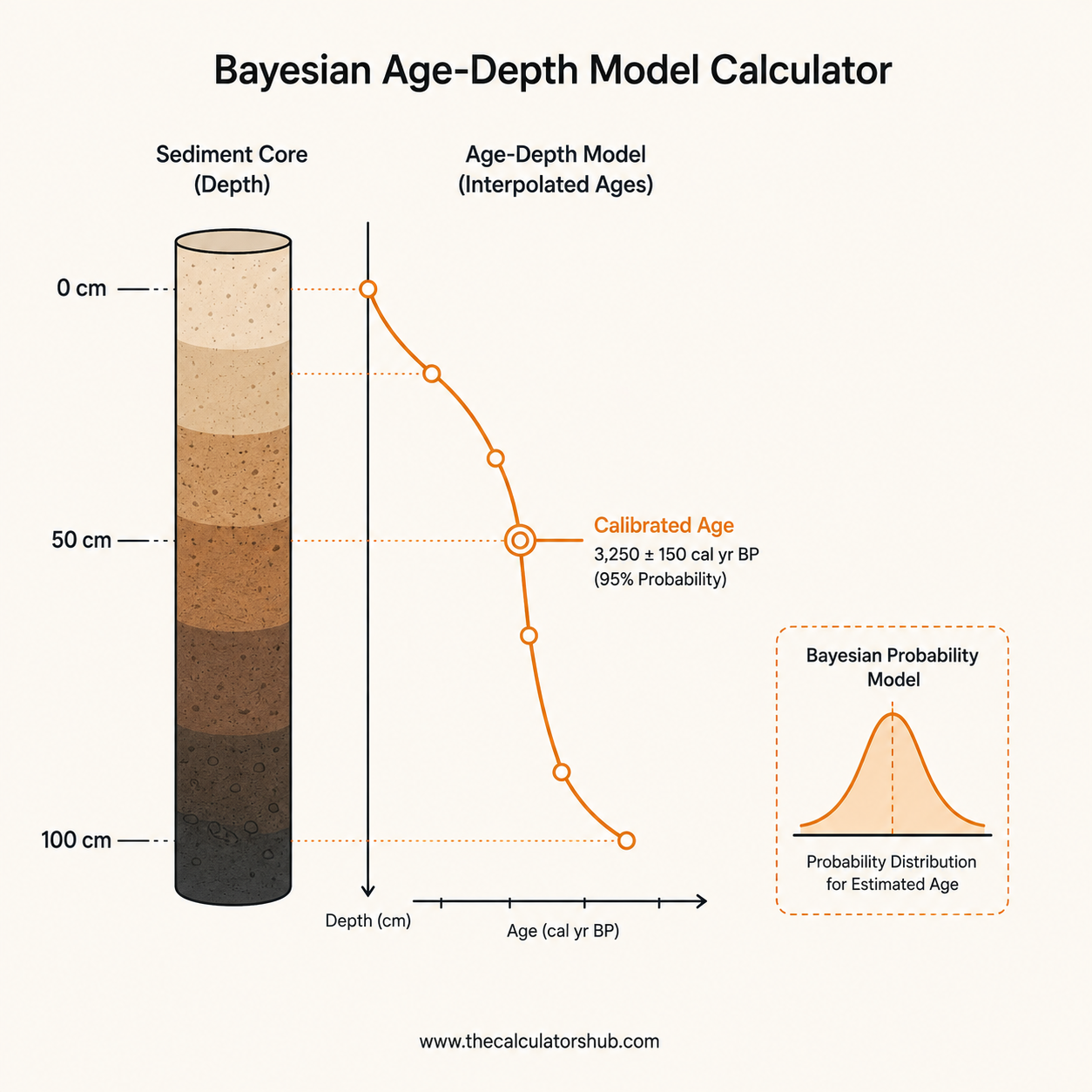
This tool works out the estimated age at any depth in a sediment or stratigraphic core by interpolating between your dated control points. Archaeologists and paleoenvironmental researchers use it to turn a handful of radiocarbon or other dated levels into a working chronology for the rest of the core, and to catch age reversals before they distort an interpretation. According to the Chrono Centre at Queen's University Belfast, an age-depth model estimates the age of undated material based on its position relative to material that has actually been dated. This tool expects calendar-calibrated cal BP ages as control points; calibrate raw radiocarbon lab measurements first with the Radiocarbon Calibration Calculator.
Linear Interpolation: The Core Method
Method | How It Works | Best Used For |
|---|---|---|
Linear interpolation (this tool) | Straight line between two bracketing dated points | Quick first-pass estimates, teaching, sanity checks |
clam (classical modelling) | Linear interpolation, regression, or smooth splines with resampled uncertainty | Standard published chronologies without full Bayesian treatment |
Bacon (rbacon, Bayesian) | Many small sections, prior-constrained accumulation rates, MCMC simulation | Publication-grade chronologies with full credible-interval ranges |
Enter your core's dated control points, depth and calibrated age for each, and the calculator finds the two points bracketing your target depth, then works out the age using straight-line interpolation, the same basic method used by the "linear" option in the widely used clam package for classical age-depth modelling. It also reports the accumulation rate implied by each segment so you can judge whether sedimentation looks consistent across your core.
What "Bacon-Style" Bayesian Modeling Adds
Full Bayesian age-depth modelling, the approach used by the widely adopted Bacon software (rbacon), developed by Maarten Blaauw and colleagues, divides the core into many small, equal-length sections and treats accumulation rate within each as a random variable, using thousands of Monte Carlo simulations to produce a full probability distribution of plausible ages at every depth. That is meaningfully more demanding than this calculator performs; what this tool provides is a simplified, linear propagation of your control points' stated uncertainty at the target depth, clearly labelled as an approximation rather than a true Bayesian credible interval.
Catching Age Reversals Before They Distort a Chronology
Under normal, undisturbed sedimentation, age should increase steadily with depth. When two adjacent control points break that pattern, the calculator flags it immediately as an age reversal rather than silently interpolating a nonsensical result. Common causes include bioturbation mixing material from different depths, sample contamination, reworked older material redeposited alongside younger sediment, and sample-ID or data-entry errors. Research on the LANDO model ensemble notes that reversed or outlying dates need to be identified and addressed before any age-depth model, simple or Bayesian, can be trusted.
Accuracy and Limitations
The interpolation math and accumulation rate calculations are exact given accurate control point data. Linear interpolation assumes a constant accumulation rate between each pair of dated points, an assumption real cores frequently violate through compaction changes, sediment source shifts, or short depositional gaps. GChron research on Bayesian age-depth modelling at Holzmaar demonstrates how much more nuanced a full model can be once genuine within-core rate variation is accounted for. Extrapolation beyond your outermost control points is considerably less reliable than interpolation between two dated levels, and this calculator flags that difference clearly.
Frequently Asked Questions

Muhammad Shahbaz Siddiqui
Founder, TheCalculatorsHub
How I used the Age-Depth Model Calculator to catch a sample mix-up before a student built an entire chronology on it
A graduate student asked for a second opinion in 2019 on a preliminary chronology for a lake-sediment core with four radiocarbon-dated control points, before she committed to a full stratigraphic interpretation. Her four points, entered from shallowest to deepest, were 450, 1620, 1180, and 3100 cal BP. She had already started sketching a narrative around the third point representing a distinct depositional event, without noticing anything unusual about the sequence itself.
Running the same four points through the reversal check flagged the problem immediately. The third control point, at 1180 cal BP, was younger than the point directly above it in the core at 1620 cal BP, an age reversal that should not occur under normal, undisturbed sedimentation, where deeper material is expected to be older, not younger. Published age-depth modelling research from GChron notes that reversals like this typically point to bioturbation, sediment reworking, a contaminated sample, or a straightforward data-entry error, not a genuine short-term climate event, which is exactly the kind of finding a young researcher building a narrative around that depth would want to know before going further.
Checking her lab notebook, the mix-up turned out to be a transcription error: the third and fourth sample IDs had been swapped when she copied results from the lab report into her spreadsheet. Once corrected, the sequence read 450, 1620, 3100, then a fourth deeper point that also fit monotonically. She re-ran her draft chronology with the corrected sequence, and the previously "unusual" depositional event she had started interpreting simply disappeared, replaced by an ordinary, steadily accumulating sequence with nothing anomalous to explain.