

How It Works
Our engine processes your inputs using verified datasets and logic models to provide real-time results.
Efficiency Tips
Ensure data accuracy for the most reliable interpretation.
Compare results across different scenarios to find the optimal path.
Did you know?
Using standardized tools reduces manual error by up to 95% in complex calculations.
Related Expert Tools
More precision tools in the same niche.
Bayesian Age-Depth Model Calculator
The Age-Depth Model Calculator interpolates the estimated calibrated age at any depth in a sediment or stratigraphic core from your dated control points, and automatically flags age reversals that would otherwise distort a chronology. It also explains what full Bayesian, Bacon-style modeling adds beyond simple linear interpolation, and reports a simplified uncertainty estimate alongside the interpolated age.
BP to BCE/CE Converter
The BP to BCE/CE Converter turns a years-before-present figure into a calendar year and back again, correctly subtracting 1949 rather than 1950 when a date crosses into BCE, since the Gregorian calendar has no year zero. It also includes an optional marine reservoir (delta-R) adjustment for converting shell and marine sample dates.
Radiocarbon Calibration Calculator
The Radiocarbon Calibration Calculator works out the conventional radiocarbon age from a lab-reported percent modern carbon or delta-14C measurement, using the standard Libby half-life convention. It also applies the marine reservoir correction (delta-R) needed for shell and marine samples, and converts a calibrated cal BP figure into a BCE or CE calendar year.
Potassium-Argon Dating Calculator Logic
Why Raw Argon-40 Isn't Radiogenic Argon-40
The mistake I see most often is treating a raw, measured ⁴⁰Ar figure as though it were already the radiogenic ⁴⁰Ar* the age equation needs, skipping the atmospheric correction entirely. Always run the atmospheric correction step first using a measured ³⁶Ar value, and check the resulting percent-radiogenic figure before trusting the calculated age, since a low percentage is a direct warning that the result is more sensitive to measurement error than the headline number suggests. Treat an unusually old result with particular caution given the excess argon problem, and where possible carry out a cross-check against independent stratigraphic evidence or a multi-sample isochron rather than relying on one bulk measurement alone.
What the Potassium-Argon Dating Calculator Actually Does
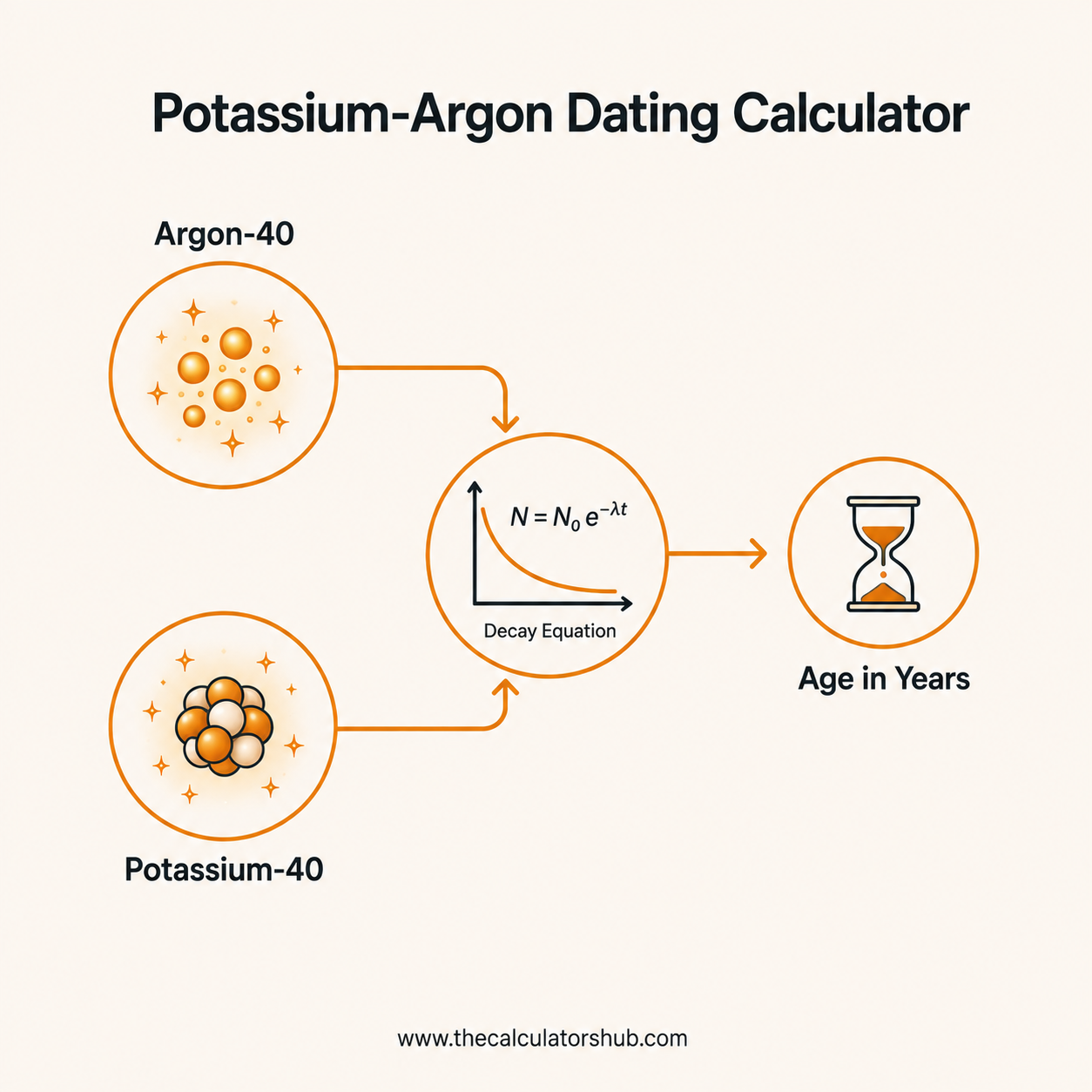
This tool works out the age of a volcanic rock or mineral from its measured argon-40 and potassium-40 content, including the atmospheric argon correction most simple tools skip entirely. Geologists and archaeologists use K-Ar dating to date volcanic layers bracketing fossil or artifact-bearing sediments, since the method works well outside radiocarbon's much shorter effective range. According to Britannica's overview of potassium-argon dating, the method compares the proportion of radioactive potassium-40 remaining against the argon-40 produced by its decay since the rock last cooled and trapped that argon.
The K-Ar Age Equation
The standard equation is t = (1/λ) × ln(1 + (λ/λₑ) × ⁴⁰Ar*/⁴⁰K), where λ is the total decay constant of potassium-40, λₑ is the electron-capture branch constant, and ⁴⁰Ar* is the radiogenic argon-40 only. This calculator uses the Steiger and Jäger (1977) decay constants adopted as the IUGS-recommended standard, corresponding to a potassium-40 half-life of approximately 1.25 billion years. Potassium-40 decays two ways: roughly 89% converts to calcium-40 through beta decay, and the remainder converts to argon-40 through electron capture; only the argon-40 branch matters for dating.
Correcting for Atmospheric Argon Contamination
Correction Step | What It Does |
|---|---|
Measure ³⁶Ar | Assumed entirely atmospheric, since ³⁶Ar is not produced by potassium decay |
Apply the atmospheric ⁴⁰Ar/³⁶Ar ratio | 295.5 (IUGS 1976) or 298.56 (CIAAW 2007) |
Subtract from measured ⁴⁰Ar | Radiogenic ⁴⁰Ar* = measured ⁴⁰Ar − (atmospheric ratio × measured ³⁶Ar) |
A raw ⁴⁰Ar measurement is very rarely pure radiogenic argon; ordinary atmosphere contains argon-40 too, and needs subtracting before the age equation gives a meaningful result. A percent-radiogenic figure under roughly 20% means the calculated age is unusually sensitive to small errors in the atmospheric ratio, and this calculator flags that condition explicitly. Research on argon degassing published in PNAS underscores how variable atmospheric argon incorporation can be across rock types.
The Excess Argon Problem
K-Ar dating assumes a sample contained zero radiogenic argon at the moment it formed. That assumption does not always hold: volcanic rocks, particularly basalts, can carry "excess argon," older argon-40 inherited from the mantle magma source rather than produced in place. Published research on excess argon in K-Ar and Ar-Ar geochronology documents this as a recognized source of anomalously old ages. Come back to this possibility whenever a K-Ar age comes out noticeably older than expected from stratigraphy, since excess argon pushes ages older, never younger.
Accuracy and Limitations
The age equation and atmospheric correction arithmetic are exact given accurate inputs and standard decay constants. This tool cannot detect excess argon contamination from a single measurement the way a full isochron analysis across multiple co-genetic samples can, and does not replace the specialized laboratory workflow described on the New Mexico Bureau of Geology's argon geochronology methods page. K-Ar dating is generally most reliable for material older than roughly 100,000 years, which is exactly why K-Ar and radiocarbon dating are usually treated as complementary methods on the same project.
Frequently Asked Questions

Muhammad Shahbaz Siddiqui
Founder, TheCalculatorsHub
How I used the Potassium-Argon Dating Calculator to explain why a volcanic tuff sample looked implausibly old
A friend working on a hominid site chronology mentioned an alarming K-Ar result in 2021, so I offered to sanity-check the volcanic tuff layer age she had calculated bracketing an important find. Her result came out roughly 40% older than every other dated layer at the site and every published comparison from the same volcanic sequence in the region, which she found alarming enough to want a second opinion before including it in her thesis chapter.
Running her measured ⁴⁰Ar and ⁴⁰K figures through the atmospheric correction step first, rather than assuming her raw ⁴⁰Ar reading was already purely radiogenic, showed the percent-radiogenic figure sitting under 15%, meaning the large majority of her measured ⁴⁰Ar was atmospheric argon, not argon produced by in-situ decay of the sample's potassium. Her original calculation had skipped the atmospheric correction entirely, using measured ⁴⁰Ar directly as if it were already radiogenic ⁴⁰Ar*, which inflates the apparent age substantially whenever atmospheric contamination makes up a large share of the total signal. The New Mexico Bureau of Geology's argon geochronology methods page describes exactly this correction step as standard practice specifically because resolving atmospheric argon from radiogenic argon is one of the most critical limitations on K-Ar accuracy in young or potassium-poor material.
Once corrected for the atmospheric component using the measured ³⁶Ar and the standard atmospheric ratio, her recalculated age fell back in line with the rest of the site's chronology, within normal measurement uncertainty of the surrounding dated layers. She flagged the correction step explicitly in her methods section going forward, and mentioned afterward that she had not fully appreciated how large a share of a measured ⁴⁰Ar signal could be atmospheric in low-potassium volcanic material until seeing her own percent-radiogenic figure come back under 15%.