
Related Expert Tools
More precision tools in the video-games niche.
Elo Rating Calculator
The Elo Rating Calculator works out your expected score and rating change from a single game against a known opponent rating, using the standard chess and competitive gaming Elo formula. Its sequence mode tracks your rating game by game across a whole series, since each game's expected score depends on your rating at that point, not your starting rating. Use it to see why a 200-point rating gap isn't twice as significant as a 100-point gap.
Encounter Calculator 5e
The Encounter Calculator 5e rates a Dungeons & Dragons combat encounter as Easy, Medium, Hard, or Deadly using the 2014 Dungeon Master's Guide XP threshold and encounter multiplier rules. Enter your party size and level, then add monsters by challenge rating, and the calculator converts CR to XP automatically rather than requiring you to look it up separately. It adjusts the encounter multiplier for unusually small or large parties.
HP Calculator 5e
The HP Calculator 5e works out a Dungeons & Dragons character's maximum hit points from class, level, and Constitution modifier, using either the fixed average method or manually entered rolls. It supports multiclass characters, applying each class's own hit die to the levels taken in that class. An optional Tough feat toggle adds the correct per-level bonus.
KD Calculator Logic
KD = Kills / Deaths; KDA = (Kills + Assists) / Deaths; Combined KD = Total Kills / Total Deaths across matchesWhy Averaging Your Match Ratios Gives the Wrong Overall KD
The mistake I see most often is averaging individual match KD ratios together instead of combining total kills and total deaths first. A 20-kill, 5-death match (4.0 KD) followed by a 3-kill, 12-death match (0.25 KD) does not average to 2.1, the simple mean of the two ratios. Combine the totals instead: 23 kills over 17 deaths gives a true combined KD of 1.35, a very different number from the naive average.
This happens because averaging ratios treats every match as equally weighted regardless of how many kills or deaths actually happened in it, which silently lets a short, lopsided match distort your real performance. Any stat tracker or leaderboard that reports your "overall KD" is combining totals, not averaging per-match ratios, so checking your own math against combined totals rather than an average of ratios is the only way to match what the game actually reports, an arithmetic distinction Purplemath's guide to combining ratios correctly explains applies well beyond gaming, to any situation where ratios from unevenly-sized samples get combined.
What the KD Calculator Actually Does
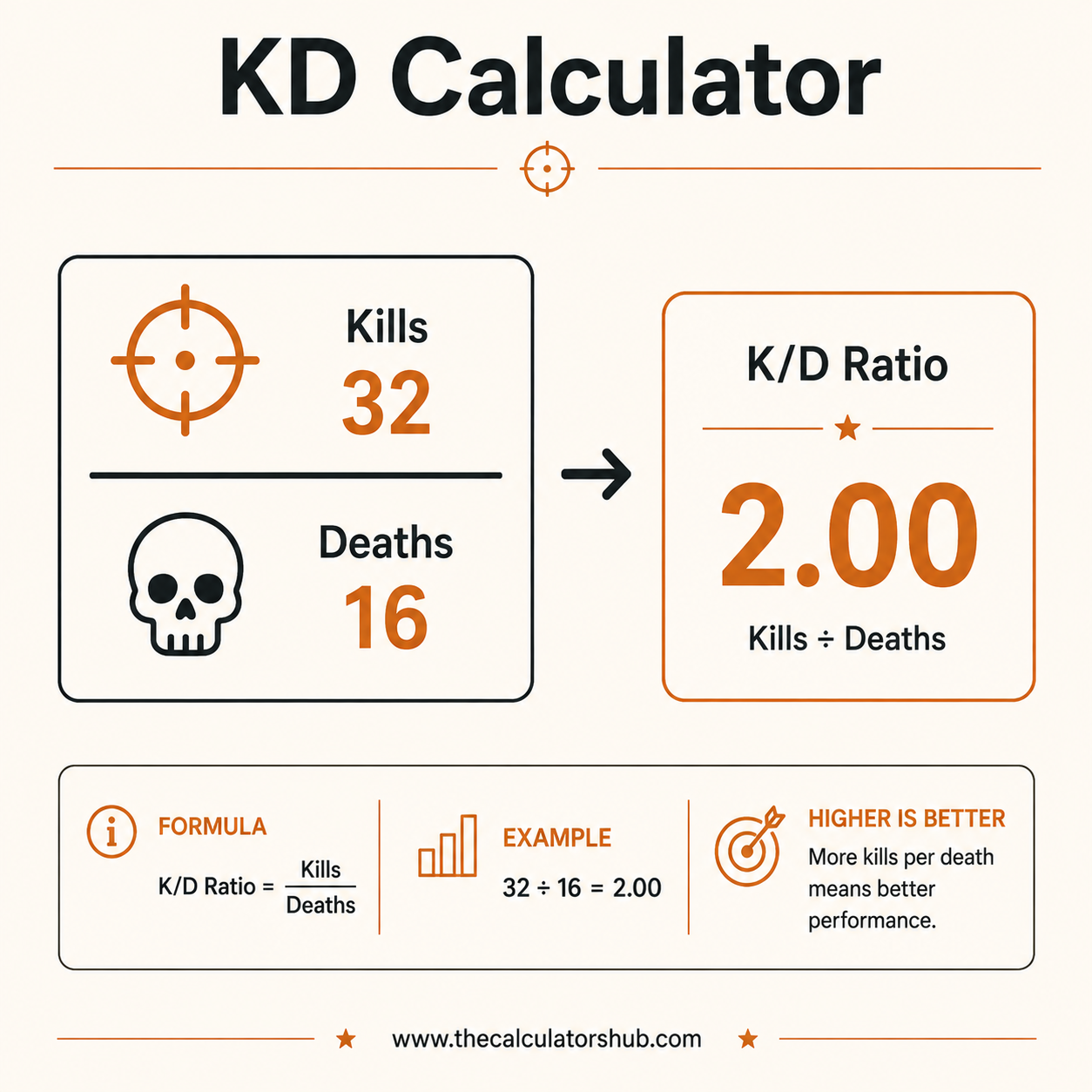
This calculator computes your kill/death ratio, the number of kills divided by the number of deaths, the standard combat efficiency metric used across shooters and battle royale games. According to Omni Calculator's KD ratio explainer, a KD of 1.0 is the baseline, meaning exactly one kill for every death, with values above 1.0 indicating more kills than deaths.
Beyond the basic ratio, it calculates KDA (kills plus assists, divided by deaths) for team-based games where assists matter, correctly combines kills and deaths across multiple matches into one true ratio, and works backward from a target ratio to show exactly how many more kills are needed without dying, or with a set number of additional deaths factored in.
KD Ratio vs KDA: Which One Matters
KD focuses purely on individual combat efficiency: kills divided by deaths, with no credit for supporting a teammate's kill. KDA, calculated as (kills plus assists) divided by deaths, gives a fuller picture in team-based games where securing an assist, weakening an enemy before a teammate finishes them, contributes real value that KD alone ignores entirely.
Metric | Formula | Best For |
|---|---|---|
KD Ratio | Kills ÷ Deaths | Solo combat efficiency, battle royale |
KDA Ratio | (Kills + Assists) ÷ Deaths | Team-based games, MOBAs, objective modes |
A player who racks up assists setting up kills for a team but rarely secures the final blow themselves can have a mediocre KD while posting a strong KDA, and that gap is meaningful information about their actual playstyle and value to the team, not a stat to be dismissed, a distinction Wikipedia's overview of MOBA scoring conventions covers, since KDA originated specifically in team-based games where assists carry real strategic weight.
What Counts as a Good KD Ratio
Interpretation varies by game and skill-based matchmaking system, but general benchmarks hold across most competitive shooters. A KD of exactly 1.00 means breaking even. The TeamzLab KD ratio guide for Warzone, Fortnite, and Apex puts 1.20 to 1.60 as a solid range for most competitive players, with anything above 2.00 representing exceptional performance, particularly meaningful in games with skill-based matchmaking that actively works to pull everyone's ratio back toward 1.0 over time.
Context matters more than the raw number: a support-focused player in an objective-based mode may deliberately trade a lower KD for more objective plays, and that tradeoff does not show up in the ratio itself, only in the outcome of the match.
KD Ratio Compared to Other Competitive Ranking Systems
KD measures raw combat output within a single game session, but it says nothing about how that performance compares to an opponent's skill level, since a 2.0 KD against weak opposition and a 2.0 KD against strong opposition are treated identically by the ratio itself. Rating systems built specifically to account for opponent strength, like the one behind our Elo Rating Calculator, answer a related but different question: not how many kills you got, but how much a given result should move your skill rating given who you played against, the same broader shift toward skill-based matchmaking that Wikipedia's overview of video game matchmaking documents across modern competitive shooters.
Accuracy and Limitations
This calculator's arithmetic is exact for the kills, deaths, and assists entered. When deaths are zero, it reports the kill count directly rather than an undefined division, matching how most stat trackers display a "perfect" record with no deaths logged.
KD and KDA say nothing about objective play, revives, damage dealt, or win contribution beyond direct combat, all of which matter in modern team-based shooters. A player optimising purely for KD can play more conservatively than their team needs, avoiding risky objective plays specifically to protect their ratio, which is a real and documented downside of over-indexing on this single number, one competitive gaming coverage revisits regularly when discussing how ranked matchmaking systems weigh objective play against raw stats. If you also play games with an assigned skill rating rather than a raw stat like KD, our Impostor Odds Calculator covers a different kind of gaming number entirely, pure chance rather than measured performance, which is a useful contrast when thinking about what a given number in a game actually represents.